
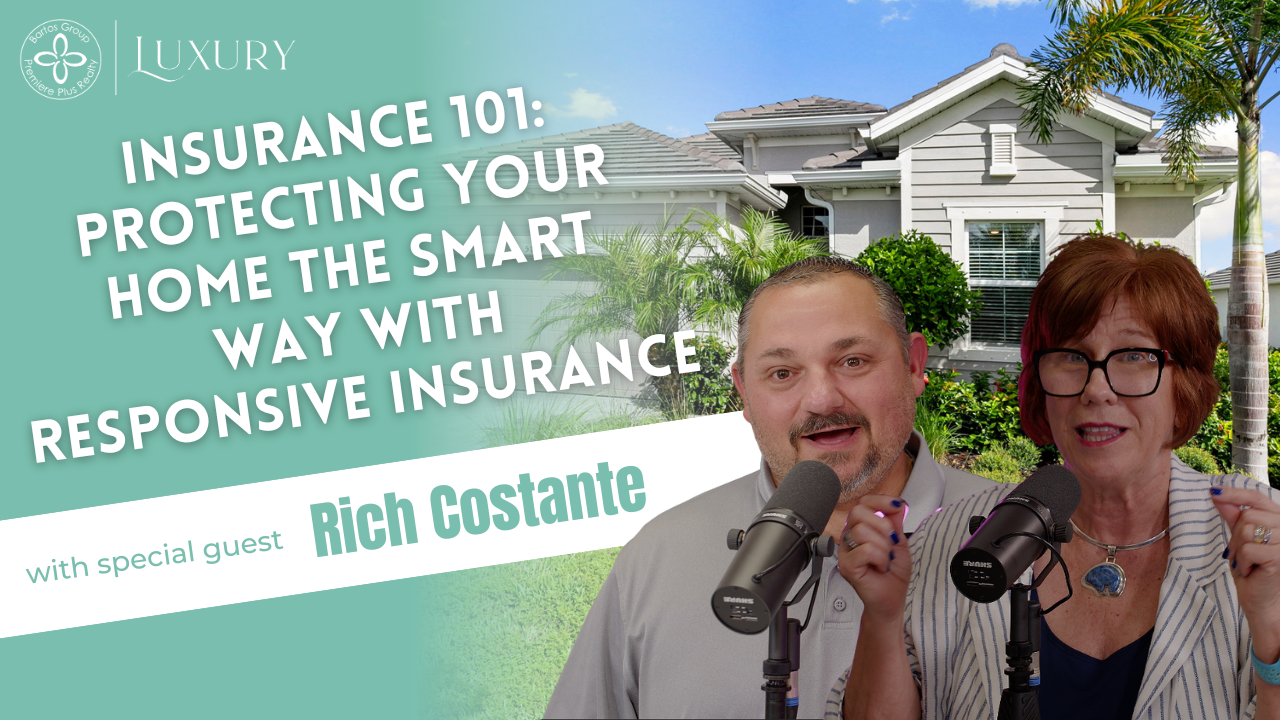
 Mary Bartos and Rich Costante break down practical, money-saving options for homeowners navigating the changing insurance landscape in Southwest Florida. Mary Bartos, team lead from the Bartos Group of Premiere Plus Realty, and Rich Costante, an insurance professional with Responsive Insurance, outline three modern strategies that can lower premiums, increase coverage flexibility, and help buyers close deals even when traditional programs are constrained.
Reviewing your home insurance? Discover smart coverage options with insights from Bartos Group.
Why Now is a Smart Time to Shop Insurance
Policy rates and carrier appetite change seasonally and after major weather events. With a calmer hurricane season and recent legislative shifts, more carriers are re-entering the market and offering creative alternatives. For anyone buying, renewing, or reviewing a homeowners package, revisiting options can often translate into savings or better protection.
Mary stresses that annual review is essential. Rich adds that newer products let homeowners make tradeoffs—accepting a bit more risk in exchange for a lower premium or choosing only the coverages that matter most to their situation.
1. Flex Homeowners Policy: Pick the Perils that Matter
The flex policy is designed for for ultimate customization. Rather than a one-size-fits-all homeowners form, this product lets the insured choose specific perils to include. That means a homeowner can tailor coverage for windstorm, hurricane, hail, water, and other perils instead of paying for a full complement of risks they may not need.
Key features Mary and Rich highlighted:
- Peril selection: Mix and match coverage for hurricane, windstorm, hail, and other exposures to reduce premium.
- Co-insurance option: Similar to health insurance coinsurance, homeowners can elect a higher share of loss above the deductible. A $10,000 or $20,000 coinsurance increases out-of-pocket exposure but lowers the annual premium.
- Flexibility for uninsured homeowners: If there is no lender requirement, combining a homeowners policy that includes wind can replace more expensive bundled options.
The tradeoff is clear: fewer covered perils equals lower cost, but more risk at claim time. Rich recommends running real-number scenarios before selecting coinsurance levels so homeowners understand likely out-of-pocket exposure after a loss.
2. Wind-only Policies and Parametric Triggers
For many coastal properties, hurricane and wind exposure drives the largest portion of the homeowners premium. Rich explains that an increasing number of carriers now offer wind-only policies that serve as a single-risk layer. This is especially useful when an existing homeowners insurer excludes windstorm or when homeowners want to split their wind coverage to a specialized market.
Important points to know about wind-only options:
- Higher capacity than before: Older options capped available wind coverage and left owners with limited choices. New carriers can write policies up to multi-million dollar limits, often beyond what legacy markets offered.
- Parametric triggers: Many wind-only solutions are parametric. They measure objective triggers such as storm category within a radius, wind speed at anemometer stations, or proximity of a storm track. Payouts are determined by the highest trigger met.
- Phase options: Single-phase, double-phase, or triple-phase structures change payout formula and premium. For example, a Category 3 storm within five miles might trigger a 75 percent payout of the policy limit in a single-phase design.
Parametric approaches speed payments and remove lengthy damage disputes, but homeowners must understand trigger mechanics and how payouts relate to actual repair costs. Rich notes underwriter flexibility: if a quoted premium is too high, carriers may work with the agent to tailor triggers or limits to meet a homeowner’s budget.
3. Private Flood Market: Stronger Coverages than NFIP
Flood risk remains one of the most damaging aspects of tropical storms. The private flood market has grown significantly, offering products that improve on National Flood Insurance Program coverage in both limits and terms.
How private flood policies compare to NFIP:
- Higher limits: Many private carriers offer building and contents limits well above the NFIP $250,000 cap. Typical private options go to $1 million or higher; some carrier programs underwrite up to $2.5 million or more.
- Replacement cost for contents and structure: Private policies are more likely to include replacement cost for building and contents versus the actual cash value restrictions that can apply under NFIP.
- Broader coverages: Private flood often includes pool repair and refill, living expense coverage, and better matching provisions for finishes and cabinetry.
For buyers with a mortgage, Freddie Mac and Fannie Mae require flood coverage that is at least as strong as NFIP. Private flood carriers that meet these guidelines can be used to satisfy lender requirements while improving homeowner protection. Rich points out that if the lender only needs building-only coverage, a certificate can often be structured to meet that requirement and lower the premium when appropriate.
Reviewing your home insurance? Discover smart coverage options with insights from Bartos Group.
How to Decide which Path is Right
Three simple steps make the decision clearer:
- List the top perils for the property location and construction: wind, flood, hail, or water.
- Compare total cost and out-of-pocket exposure across scenarios: full homeowners, flex perils with coinsurance, and layered wind-only or private flood options.
- Work with an agent who can run multiple carrier quotes and explain parametric triggers, coinsurance mechanics, and flood limit tradeoffs.
Mary emphasizes the value of local expertise. Rich underscores that carriers are actively adapting offerings to win business and that homeowners should not assume there are no solutions simply because a traditional market tightened.
Common Situations Where These Products Help
- Older coastal homes with strong foundational value but high replacement cost exposure.
- High-net-worth homes where total dwelling limits exceed legacy market caps.
- Buyers trying to close during coverage gaps or when the NFIP is temporarily constrained.
Frequently asked questions
Can a homeowner with a mortgage use private flood instead of NFIP?
Yes. Provided the private flood policy meets Freddie Mac and Fannie Mae guidelines and the lender accepts the private carrier, private flood can replace NFIP and often provides higher limits and better coverage terms.
What does coinsurance mean on a homeowners flex policy?
Coinsurance means the homeowner shares a percentage of loss above the deductible. Choosing coinsurance lowers the premium but increases out-of-pocket cost at claim time. It functions like coinsurance in health plans: the carrier pays after the homeowner meets the deductible and coinsurance thresholds.
How do parametric wind-only policies pay out?
Parametric policies pay based on measured triggers such as storm category near the property, wind speed recorded by stations, or proximity of a storm track. If a trigger is met, the policy pays according to a pre-agreed scale rather than measuring actual damage onsite.
Are wind-only policies a replacement for homeowners insurance?
No. Wind-only policies cover only hurricane or windstorm damage above specific thresholds. They are typically used in conjunction with a homeowners or dwelling policy that covers other perils, or as a way to shift wind exposure to a specialized market.
How often should homeowners shop their insurance?
At least annually, or when there is a significant change in property value, renovations, or after major weather events. Market conditions and new carriers can create opportunities to improve terms or reduce cost.
Final Takeaways
Southwest Florida homeowners have more choices than many assume. The flex homeowners policy provides tailored peril selection and coinsurance options to control premiums. Wind-only parametric policies offer high-capacity coverage for coastal risks. The private flood market delivers stronger limits and broader benefits than the NFIP. Working with a knowledgeable local agent can uncover combinations that reduce cost while protecting what matters most.
Insurance decisions are nuanced. Mary and Rich recommend reviewing coverage annually and discussing real-dollar scenarios before making tradeoffs. With the right approach, homeowners can protect their investment and reduce surprise exposure when storms come ashore.