
Most agents do not have a lead problem. They have a real estate systems problem.
Building Better Systems? Discover how Bartos Group approaches consistent real estate growth.
In this blog featuring Mary Bartos with the Bartos Group and top Tom Ferry Coach Tausha Fournier, they breakdown this hard truth. In this market, too many agents are busy chasing the next hot lead, hoping the phone rings, hoping Zillow delivers, hoping somebody in the database suddenly decides to move. That approach creates the classic income roller coaster. One month is great. The next month is panic.
The better path is not more hustle. It is better structure. Strong real estate systems turn random activity into predictable business, and they keep agents from burning out while millions in future commission quietly slip away.
One of the most overlooked opportunities is sitting right inside the database. Only about one in five consumers actually reuse the same Realtor, yet 80% to 90% say they would. That gap is not because clients do not want a relationship. It is usually because the agent never built a system to stay in touch.
That is where the conversation needs to start.
Why agents are struggling right now
The biggest struggle in real estate is not effort. It is inconsistency.
Agents are often working hard, but they are working reactively. They chase the lead that looks hottest in the moment. They follow urgency instead of process. They keep critical tasks in their head. Then they wonder why the business feels stressful, messy, and unpredictable.
A great quote shared in this conversation comes from James Clear:
“You do not rise to the level of your goals. You fall to the level of your systems.”
That idea applies perfectly to real estate. If an agent has goals without real estate systems, the business becomes a constant chase. If the systems are in place, the next ready client tends to bubble up naturally because the agent is always having conversations, always following up, and always staying visible.
The 5 core real estate systems every agent needs
Tausha Fournier boiled the business down to five foundational systems. None of them are flashy. All of them are profitable.
1. A schedule is a system
This one surprises a lot of people.
A schedule is not just a calendar. It is a business system. It gives structure to the activities that create income. Without it, an agent wakes up and asks, “What am I supposed to do today?” If there is no urgent lead, the day gets hijacked by distractions, admin work, or other people’s priorities.
If it is not on the schedule, it does not exist.
That means an effective schedule should include time for:
- Lead generation
- Follow-up
- Client communication
- Transaction-related tasks
- Database nurture
The point is simple. Agents who direct their time create revenue. Agents who wait for revenue to find them stay stuck in reaction mode.
2. A CRM that actually works
A contact list is not a CRM. A real CRM is one of the most important real estate systems in the business because it works when the agent is not working.
That means it should do more than store names and numbers. It should help nurture past clients, keep leads warm, remind the agent when to follow up, and make sure opportunities do not die because somebody forgot to call.
Too many agents are running the business inside their own head. That is why they wake up at 2 a.m. remembering a client they forgot to contact. Memory is not a system.
A properly optimized CRM should help with:
- Follow-up reminders
- Lead status tracking
- Past client touch plans
- Sphere of influence communication
- Behavior alerts, such as when someone engages with property or home value content
When the CRM is doing its job, the agent stops guessing and starts managing relationships intentionally.
3. A lead generation system
This is where many agents get into trouble. They have lead sources, but they do not have a lead generation system.
There is a difference.
A lead source is where names come from. A system is the scheduled, repeatable process that turns those names into conversations. And in real estate, conversations are still the fuel.
One of the clearest rules shared in the discussion was this: he or she who talks to the most people wins.
That does not mean random chatter. It means consistent, intentional outreach.
A lead generation system should include:
- Specific time blocks each week for prospecting
- Clear follow-up actions after every conversation
- A process for email or message follow-up
- Consistency, even when no deal looks immediate
The foundational piece is not the fancy add-ons. It is doing the activities that create conversations every single week. Without that, the business stays reactive. With it, opportunities begin to surface much more predictably.
4. A transaction management system
Agents are often excellent at building rapport, handling objections, and getting to contract. That does not automatically mean they are great at paperwork, deadlines, and compliance.
In fact, many are not. And that is okay, as long as they admit it and put a system in place.
Every transaction has moving parts, recurring timelines, and critical due dates. Inspection periods, deposits, paperwork, repairs, contingency deadlines. Trying to manage all of that mentally is how balls get dropped.
This is one of the most practical real estate systems because it protects both the client experience and the agent’s sanity.
A strong transaction management system might include:
- A transaction coordinator
- Team support
- A checklist-based workflow
- Calendar reminders tied to contract deadlines
- Standard operating procedures for each stage of the deal
For solo agents, the answer may be hiring help. For others, it may be joining a team that already provides transaction coordination. The point is not to become great at every task. The point is to stop pretending that winging it is a strategy.
Building Better Systems? Discover how Bartos Group approaches consistent real estate growth.
5. A client management system before and after the sale
This may be the most expensive gap of all.
Most agents say they stay in touch with past clients and their sphere of influence. But when asked how, the answer is often something like, “When I think about them, I call.”
That is not a client management system. That is a random act of memory.
People move for all kinds of reasons, and those reasons do not appear on the agent’s internal clock. If the relationship is not maintained systematically, somebody else will be top of mind when that move happens.
There is another trap too. Agents tend to call their favorites. They stay connected to the clients who are easy, fun, and familiar. Meanwhile, lower-maintenance people get ignored because the agent assumes the relationship is secure. Then a holiday card comes back undeliverable, or a casual check-in reveals they already moved with someone else.
A client management system should cover both active clients and long-term relationships after closing. This can include:
- Regular calls or check-ins
- Email updates
- Home value reports
- Neighborhood pricing information
- Client events
- Behavior-based alerts that signal possible selling interest
The goal is simple: stay useful, stay relevant, and stay remembered.
The myth that follow-up feels “salesy”
One of the biggest mental blocks agents carry is the fear of bothering people.
They do not want to sound pushy. They do not want to feel salesy. So they avoid reaching out, especially to past clients. That story sounds polite, but the data says otherwise.
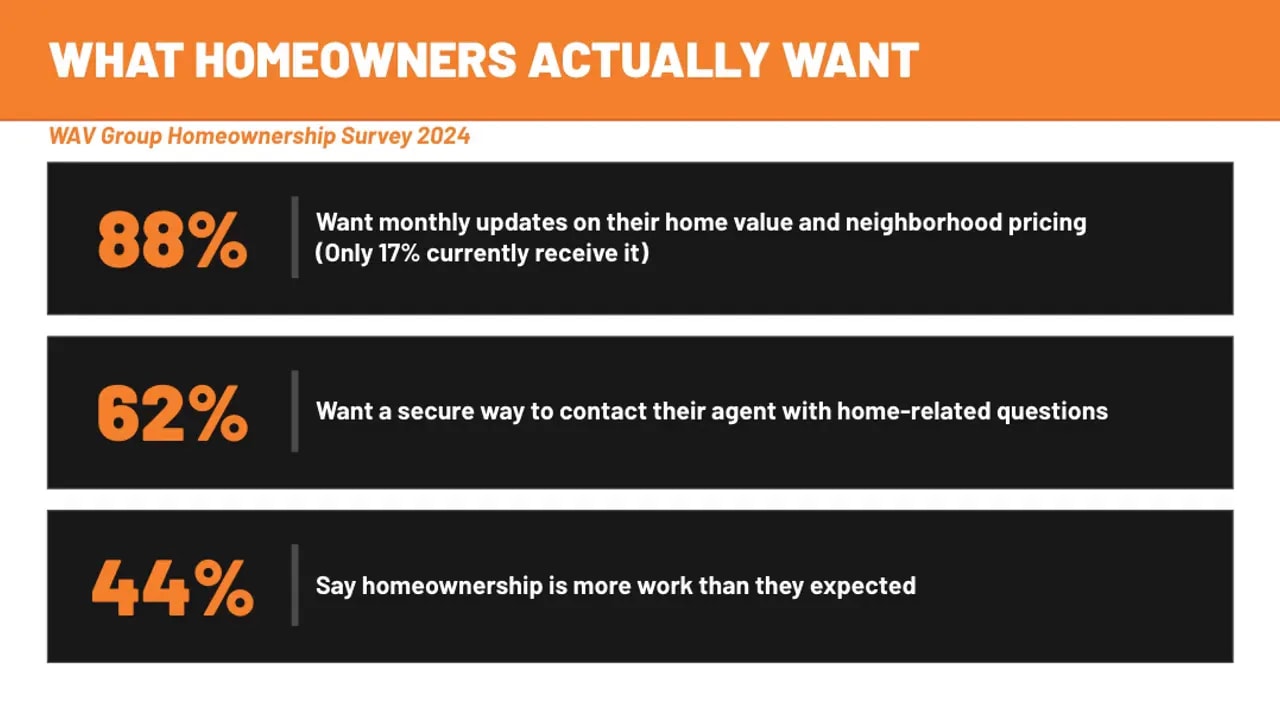
According to the 2024 WAV Group homeownership survey cited in the discussion, 88% of homeowners want a monthly update on their home value and neighborhood pricing. Only 17% are getting it.
That should stop every agent in their tracks.
Clients want the information. They want the expertise. They want help staying informed about one of their biggest assets. Agents are not annoying people by offering value. They are often failing people by staying silent.
The same survey found that 44% of homeowners said homeownership was more work than they expected and that issues came up that concerned them. That means people need resources after the closing too. They need vendor referrals, guidance, reassurance, and answers.
The sale is not the end of the relationship. It should be the start of a long one.
What scalable real estate systems really do
At their best, real estate systems do three things:
- They reduce stress because the business no longer lives in the agent’s head.
- They increase consistency because core tasks happen on schedule, not by mood.
- They improve conversion because more people are being contacted, nurtured, and served at the right time.
That is the real difference between a reactive agent and a scalable business. The reactive agent waits for activity. The scalable business creates the conditions for activity every week.
And in a market where repeat business and referrals should be a gold mine, those systems are not optional anymore.
FAQ
What are the most important real estate systems for agents?
The five most important real estate systems are scheduling, CRM management, lead generation, transaction management, and client management. Together, they create structure for prospecting, follow-up, deal flow, and long-term client retention.
Why do most agents lose repeat business from past clients?
Most agents do not lose repeat business because clients were unhappy. They lose it because they did not stay in touch consistently. Without a client management system, the relationship fades and another agent becomes top of mind when a move happens.
How often should agents contact past clients?
The key is regular, systemized contact rather than random check-ins. Monthly home value and neighborhood updates are especially valuable, since the survey referenced found that 88% of homeowners want that information.
Is a CRM really necessary if an agent has a small database?
Yes. A CRM is useful at any size because it prevents follow-up from being managed by memory alone. Even a small database becomes hard to manage consistently without reminders, task tracking, and structured outreach.
What is the difference between a lead source and a lead generation system?
A lead source is where names come from, such as Zillow or referrals. A lead generation system is the repeatable process used to create conversations, follow up, and move those contacts toward a transaction.
The bottom line
Agents do not need to do everything. They do need to stop operating without a framework.
The business gets easier when the right real estate systems are in place. The schedule creates focus. The CRM creates consistency. Lead generation creates conversations. Transaction management protects the deal. Client management protects the relationship long after closing.
And perhaps most importantly, those systems help agents stop telling themselves the wrong story. Past clients are not being bothered. Homeowners are not asking for less communication. In many cases, they are actively hoping for more.
That is the opportunity in 2026. Not just to close the next deal, but to build a business where fewer clients slip away, fewer tasks fall through the cracks, and far less commission gets left on the table.